

The Federal Civil Service Job Classification System Uses Which Type Of Job Evaluation System?
Learning Objectives
- Explicate types of job evaluation systems and their uses.
- Exist able to define and discuss the types of pay systems and factors determining the blazon of pay organisation used.
- Know the laws relating to compensation.
Once you take determined your compensation strategy based on internal and external factors, you will demand to evaluate jobs, develop a pay organisation, and consider pay theories when making decisions. Next, you will decide the mix of pay yous will use, taking into consideration legal implications.
Figure 6.two The Process for Implementing Compensation Strategy

Job Evaluation Systems
As mentioned when we discussed internal and external factors, the value of the job is a major factor when determining pay. There are several ways to determine the value of a job through job evaluation. Job evaluation is defined every bit the process of determining the relative worth of jobs to determine pay structure. Job evaluation tin assist u.s.a. determine if pay is equitable and fair among our employees. There are several ways to perform a job evaluation. Ane of the simplest methods, used by smaller companies or within private departments, is a job ranking system. In this type of evaluation, job titles are listed and ranked in order of importance to the organization. A paired comparison tin can likewise occur, in which private jobs are compared with every other task, based on a ranking system, and an overall score is given for each job, determining the highest-valued task to the lowest-valued task. For example, in Table 6.ane "Example of a Paired Comparing for a Chore Evaluation", four jobs are compared based on a ranking of 0, one, or two. Zero indicates the task is less of import than the one being compared, 1 means the job is about the same, and 2 ways the job is more important. When the scores are added upwards, information technology is a quick mode to see which jobs are of more than importance to the organization. Of form, any person creating these rankings should be familiar with the duties of all the jobs. While this method may provide reasonably proficient results because of its simplicity, information technology doesn't compare differences between jobs, which may have received the aforementioned rank of importance.
Tabular array half dozen.one Case of a Paired Comparing for a Job Evaluation
| Job | Receptionist | Project Manager | Account Managing director | Sales | Director |
|---|---|---|---|---|---|
| Receptionist | X | 0 | 0 | 0 | 0 = 4th |
| Project Administrative Assistant | 1 | Ten | 0 | 0 | ane = 3rd |
| Account Manager | ii | 1 | X | 0 | 3 = second |
| Sales Director | 2 | two | 2 | X | vi = 1st |
| Based on the paired ranking system, the sales director should take a college bacon than the project authoritative banana, because the ranking for that job is higher. Too, a receptionist should exist paid less than the project administrative assistant because this job ranks lower. | |||||
In a job nomenclature organization , every job is classified and grouped based on the noesis and skills required for the job, years of experience, and amount of dominance for that job. The US military is maybe the all-time known for this type of nomenclature system. The navy, for instance, has job nomenclature codes, such as HM (hospitalman). Then the jobs are divided into specialties, such every bit HM-8483, the classification for surgical technologist, and HM-8451 for a hospitalman-X-ray technician. The federal government and most country governments use this type of system. Tied to each job are the basic function, characteristics, and typical work of that task classification, along with pay range data. A sample of a job classification system is shown in Table six.2 "Example of a Task Classification Organisation at the Academy of Washington".
Table vi.2 Example of a Job Classification System at the University of Washington
| Job Code | Job Title | State Task Course Code Reference | Representative Group | Pay Tabular array | Pay Range | Minimum Mo. Charge per unit | Maximum Mo. Incremental Rate | OT Eligible |
|---|---|---|---|---|---|---|---|---|
| 7715 | ACCELERATOR TECHNICIAN 1 | SEIU Local 925 Clerical Nonsupervisory | B4 | 40 | $2689 | $3583 | Y | |
| 7300 | ACCOUNTANT 1 | SEIU Local 925 Clerical Nonsupervisory | B4 | 40 | $2689 | $3583 | Y | |
| 7301 | Accountant 2 | SEIU Local 925 Clerical Nonsupervisory | B4 | 44 | $2949 | $3956 | N | |
| 7302 | Accountant, SENIOR | SEIU Local 925 Clerical Nonsupervisory | B4 | 50 | $3410 | $4587 | North | |
| 7011 | ACCOUNTING SUPERVISOR | SEIU Local 925 Clerical Supervisory | B4 | 50 | $3410 | $4587 | Due north | |
| 7045 | ADMINISTRATIVE Assistant A | SEIU Local 925 Clerical Nonsupervisory | B4 | 39 | $2623 | $3493 | Y | |
| 7044 | Administrative Assistant A-SUPV | SEIU Local 925 Clerical Supervisory | B4 | 41 | $2751 | $3667 | Y | |
| 7046 | ADMINISTRATIVE ASSISTANT B | SEIU Local 925 Clerical Supervisory | B4 | 42 | $2816 | $3763 | Y | |
| 7080 | ADMINISTRATIVE COORDINATOR | SEIU Local 925 Clerical Nonsupervisory | B4 | 37 | $2506 | $3325 | Y | |
| 7490 | ADMISSIONS SPECIALIST | SEIU Local 925 Clerical Nonsupervisory | B4 | 41 | $2751 | $3667 | Y | |
| 7583 | AFFIRMATIVE ACTION/Homo RIGHTS ASST | SEIU Local 925 Clerical Nonsupervisory | B4 | 41 | $2751 | $3667 | Y | |
| 8696 | ALCOHOLISM THERAPIST 1 | WFSE HMC | B0 | 56 | $3507 | $5021 | Y | |
| 6119 | ALCOHOLISM THERAPIST 2 | 359F | Classified Non-Union | C0 | 63 | $3761 | $5224 | Y |
| 6329 | ANATOMIC PATHOLOGY LABORATORY LEAD | 315H | Classified Non-Union | C0 | 73 | $4154 | $5771 | Y |
| 6328 | ANATOMIC PATHOLOGY LABORATORY SUPERVISOR | 315I | Classified Non-Wedlock | C0 | 79 | $4412 | $6126 | N |
| 8146 | ANATOMIC PATHOLOGY TECHNICIAN | SEIU Local 925-HMC Technical | B7 | 55 | $3472 | $4822 | Y | |
| 8326 | ANATOMIC PATHOLOGY TECHNICIAN | SEIU LOCAL 925 Medical/Laboratory Tech | B7 | 55 | $3472 | $4822 | Y | |
| 8145 | ANATOMIC PATHOLOGY TECHNICIAN TRAINEE | SEIU Local 925-HMC Technical | B7 | xl | $2991 | $4155 | Y | |
| 8325 | ANATOMIC PATHOLOGY TECHNICIAN TRAINEE | SEIU LOCAL 925 Medical/Laboratory Tech | B7 | twoscore | $2991 | $4155 | Y | |
| 8147 | ANATOMIC PATHOLOGY TECHNOLOGIST | SEIU Local 925-HMC Technical | B7 | 66 | $3874 | $5383 | Y | |
| 8327 | ANATOMIC PATHOLOGY TECHNOLOGIST | SEIU LOCAL 925 Medical/Laboratory Tech | B7 | 66 | $3874 | $5383 | Y | |
| 6313 | ANESTHESIOLOGY TECHNICAL SERVICES SUPV | 320H | Classified Non-Union | CA | 61 | $3686 | $5277 | North |
| 6310 | ANESTHESIOLOGY TECHNICIAN 1 | 320E | Classified Non-Wedlock | CA | 13 | $2287 | $3271 | Y |
| 8711 | ANESTHESIOLOGY TECHNICIAN 1 | WFSE HMC | BA | x | $2219 | $3271 | Y | |
| 8312 | ANESTHESIOLOGY TECHNICIAN two | SEIU LOCAL 925 Medical/Laboratory Tech | BS | 46 | $3344 | $4933 | Y | |
| 8960 | ANESTHESIOLOGY TECHNICIAN 2 | 1199NW-HMC Respiratory/Anesthesiology | BS | 46 | $3344 | $4933 | Y | |
| 6311 | ANESTHESIOLOGY TECHNICIAN Lead | 320G | Classified Not-Wedlock | CA | 52 | $3370 | $4826 | Y |
| 8959 | ANESTHESIOLOGY TECHNICIAN LEAD | 1199NW-HMC Respiratory/Anesthesiology | BS | 53 | $3585 | $5288 | Y | |
| 7724 | Animal TECHNICIAN 1 | SEIU Local 925 Clerical Nonsupervisory | B4 | 25 | $1903 | $2506 | Y | |
| 7725 | Brute TECHNICIAN 2 | SEIU Local 925 Clerical Nonsupervisory | B4 | 26 | $1948 | $2567 | Y | |
| 7726 | Animate being TECHNICIAN 3 | SEIU Local 925 Clerical Nonsupervisory | B4 | 30 | $2134 | $2816 | Y | |
| 4727 | Brute TECHNICIAN SUPERVISOR | 525H | Classified Non-Union | C1 | 35 | $2370 | $3063 | Y |
| 4658 | Banana FACILITIES DESIGNER | 540L | Classified Non-Wedlock | C1 | 48 | $3213 | $4214 | Y |
| 8874 | Assistant STEAM ENGINEER | WFSE Skilled Trades | BL | 46G | $3566 | $4106 | Y | |
| 8507 | BAKER | WFSE Campuswide | BI | 30 | $2113 | $2789 | Y | |
| 8508 | BAKER Atomic number 82 | WFSE Campuswide | BI | 33 | $2266 | $2994 | Y | |
| 4700 | BIOMEDICAL ELECTRONICS TECHNICIAN 1 | 511E | Classified Non-Union | CA | 54 | $3438 | $4924 | Y |
| 4701 | BIOMEDICAL ELECTRONICS TECHNICIAN ii | 511F | Classified Not-Matrimony | CA | 68 | $3954 | $5659 | Y |
| 4702 | BIOMEDICAL ELECTRONICS TECHNICIAN iii | 511G | Classified Non-Union | CA | 78 | $4368 | $6249 | Y |
| 4703 | BIOMEDICAL ELECTRONICS TECHNICIAN Atomic number 82 | 511H | Classified Not-Union | CA | 83 | $4591 | $6568 | Y |
| 4704 | BIOMEDICAL ELECTRONICS TECHNICIAN SUPV | 511I | Classified Not-Union | CA | 88 | $4826 | $6903 | N |
| 8875 | BOILER OPERATOR | WFSE Skilled Trades | BL | 42G | $3247 | $3736 | Y | |
| 7613 | Book PRODUCTION COORDINATOR | SEIU Local 925 Clerical Nonsupervisory | B4 | 44 | $2949 | $3956 | Y | |
| 7075 | Bookkeeping MACHINE OPERATOR | SEIU Local 925 Clerical Nonsupervisory | B4 | 29 | $2088 | $2751 | Y | |
| 7550 | BROADCAST TECHNICIAN 1 | SEIU Local 925 Clerical Nonsupervisory | B4 | 41 | $2751 | $3667 | Y | |
| 7551 | BROADCAST TECHNICIAN 2 | SEIU Local 925 Clerical Nonsupervisory | B4 | 47 | $3166 | $4255 | Y | |
| 7552 | Circulate TECHNICIAN 3 | SEIU Local 925 Clerical Nonsupervisory | B4 | 51 | $3493 | $4699 | Y | |
| 7553 | BROADCAST TECHNICIAN SUPERVISOR | SEIU Local 925 Clerical Supervisory | B4 | 55 | $3856 | $5186 | N | |
| 7335 | Upkeep ANALYST | SEIU Local 925 Clerical Nonsupervisory | B4 | 42 | $2816 | $3763 | Y | |
| 7336 | Budget/FISCAL Annotator | SEIU Local 925 Clerical Nonsupervisory | B4 | 46 | $3093 | $4154 | N | |
| 7337 | BUDGET/FISCAL Annotator Pb | SEIU Local 925 Clerical Nonsupervisory | B4 | 51 | $3493 | $4699 | N | |
| 7339 | Budget/FISCAL OPERATIONS SUPERVISOR | SEIU Local 925 Clerical Supervisory | B4 | 57 | $4053 | $5448 | Northward | |
| 7338 | Budget/Fiscal Unit of measurement SUPERVISOR | SEIU Local 925 Clerical Supervisory | B4 | 54 | $3763 | $5059 | N | |
| 7021 | BUILDING SERVICES COORDINATOR | SEIU Local 925 Clerical Nonsupervisory | B4 | 33 | $2289 | $3023 | Y | |
| 7022 | BUILDING SERVICES SUPERVISOR | SEIU Local 925 Clerical Supervisory | B4 | 38 | $2567 | $3410 | Y | |
| 5215 | BUILDINGS AND GROUNDS SUPERVISOR A | 598G | Classified Non-Union | C1 | 49 | $3293 | $4322 | N |
| 5216 | BUILDINGS AND GROUNDS SUPERVISOR B | 598H | Classified Non-Marriage | C1 | 55 | $3819 | $5010 | N |
| 7119 | BUYER 1 | SEIU Local 925 Clerical Nonsupervisory | B4 | 38 | $2567 | $3410 | Y | |
| 7120 | BUYER 2 | SEIU Local 925 Clerical Nonsupervisory | B4 | 44 | $2949 | $3956 | Y | |
| 7122 | BUYER 3 | SEIU Local 925 Clerical Nonsupervisory | B4 | 49 | $3325 | $4472 | N | |
[ane]
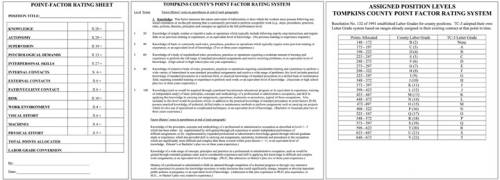
Another blazon of task evaluation system is the betoken-factor arrangement , which determines the value of a job by calculating the total points assigned to it. The points given to a specific task are called compensable factors . These can range from leadership ability to specific responsibilities and skills required for the job. In one case the compensable factors are determined, each is given a weight compared to the importance of this skill or ability to the organization. When this arrangement is applied to every job in the organization, expected compensable factors for each job are listed, forth with corresponding points to determine which jobs accept the most relative importance within the organization. Tompkins County in New York uses a point-gene organisation. Some of their compensable factors include the following:
- Knowledge
- Autonomy
- Supervision
- Psychological demands
- Interpersonal skills
- Internal and external contacts
In this point-factor system, autonomy ranks the highest and is given a weight of 20-nine, while noesis is given a charge per unit of twenty, for example. Each of the compensable factors has a narrative that explains how points should be distributed for each factor. In this organisation, one hundred points are given for knowledge for a bachelor's caste and two to iii years of experience, and lxxx points are given if an employee has an associate'south degree or high school diploma and two to iii years of experience. The points are then multiplied by the weight (for noesis, the weight is twenty) to requite a final score on that compensable factor. Later a score is developed for each, the employee is placed on the appropriate pay level for his or her score, equally illustrated in Figure 6.three "Example of a Point-Cistron System".
Effigy 6.3 Case of a Point-Factor Organisation
Another option for chore evaluation is called the Hay profile method . This proprietary job evaluation method focuses on iii factors called know-how, trouble solving, and accountability. Inside these factors are specific statements such as "procedural proficiency." Each of these statements is given a point value in each category of know-how, problem solving, and accountability. Then chore descriptions are reviewed and assigned a set of statements that near accurately reverberate the task. The point values for each of the statements are added for each job description, providing a quantitative basis for job evaluation and eventually, bounty. An advantage of this method is its quantitative nature, only a disadvantage is the expense of performing an elaborate job evaluation.
Pay Systems
Once you take performed a job evaluation, yous can motility to the third pace, which nosotros call pay grading . This is the process of setting the pay calibration for specific jobs or types of jobs.
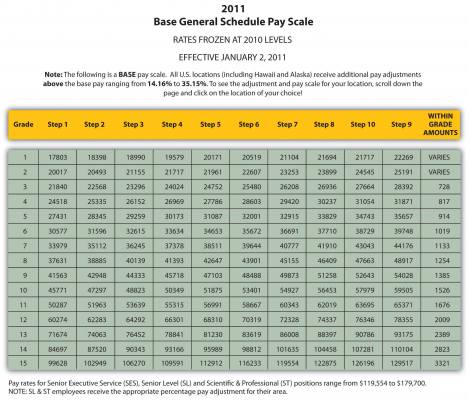
The commencement method to pay grade is to develop a diversity of pay grade levels . Figure vi.iv "Sample Pay Scale for General Federal Jobs" shows an instance. So one time the levels are developed, each job is assigned a pay grade. When employees receive raises, their raises stay within the range of their private pay form, until they receive a promotion that may result in a higher pay class. The advantage of this type of arrangement is fairness. Everyone performing the same job is inside a given range and there is trivial room for pay bigotry to occur. Even so, since the system is rigid, it may non be appropriate for some organizations in hiring the best people. Organizations that operate in several cities might utilize a pay form scale, only they may add percentages based on where someone lives. For example, the price of living in Spokane, Washington, is much lower than in New York City. If an organization has offices in both places, it may choose to add a percent pay adjustment for people living inside a geographic area—for example, 10 percent higher in New York.
One of the downsides to pay grading is the possible lack of motivation for employees to work harder. They know even if they perform tasks exterior their job description, their pay level or pay grade will be the same. This tin incubate a stagnant environment. Sometimes this system can also create too many levels of hierarchy. For large companies, this may work fine, but smaller, more than active organizations may use other methods to determine pay structure. For case, some organizations take moved to a delayering and banding process, which cuts down the number of pay levels within the arrangement. Full general Electrical delayered pay grades in the mid-1990s considering information technology found that employees were less probable to take a reassignment that was at a lower pay form, even though the assignment might accept been a good evolution opportunity.Gerald Ferris, Handbook of Human Resource Direction (Cambridge, MA: Blackwell, 1995). And so, delayering enables a broader range of pay and more flexibility inside each level. Sometimes this type of process also occurs when a company downsizes. Allow'southward assume a company with 5 hundred employees has traditionally used a pay grade model simply decided to move to a more than flexible model. Rather than accept, say, thirty pay levels, it may reduce this to five or half dozen levels, with greater salary differentials within the grades themselves. This allows organizations to amend advantage performance, while still having a basic model for hiring managers to follow.
Effigy six.iv Sample Pay Calibration for Full general Federal Jobs
Rather than employ a pay form scale, some organizations apply a going rate model . In this model, analysis of the going rate for a particular task at a particular time is considered when creating the compensation package. This model tin work well if market pressures or labor supply-and-demand pressures profoundly touch your item business concern. For instance, if you demand to concenter the best project managers, but more than are already employed (lack of supply)—and nearly companies are paying $75,000 for this position—yous volition likely need to pay the same or more than, considering of labor supply and demand. Many tools are available, such as salarywizard.com, to provide going charge per unit information on detail jobs in every region of the U.s.a..
Compensation Strategies
The president of HR That Works provides some tips on determining compensation.
Another pay model is the management fit model . In this model, each director makes a conclusion about who should exist paid what when that person is hired. The downside to this model may be potential discrimination, halo furnishings, and resentment within the organization. Of form, these factors can create morale issues, the verbal thing we want to avert when compensating employees.
In addition to the pay level models nosotros just looked at, other considerations might include the following:
- Skill-based pay. With a skill-based pay system, salary levels are based on an employee's skills, every bit opposed to job title. This method is implemented similarly to the pay grade model, but rather than job title, a set of skills is assigned a item pay grade.
- Competency-based pay. Rather than looking at specific skills, the competency-based arroyo looks at the employee's traits or characteristics as opposed to a specific skills set. This model focuses more than on what the employee can become every bit opposed to the skills he or she already has.
- Broadbanding. Broadbanding is similar to a pay form system, except all jobs in a particular category are assigned a specific pay category. For instance, everyone working in customer service, or all authoritative assistants (regardless of department), are paid inside the aforementioned full general band. McDonald'south uses this bounty philosophy in their corporate offices, stating that it allows for flexibility in terms of pay, motility, and growth of employees. [2]
- Variable pay system. This type of system provides employees with a pay basis but then links the attainment of certain goals or achievements directly to their pay. For example, a salesperson may receive a certain base pay but earn more if he or she meets the sales quota.
How Would Y'all Handle This?
Y'all have been working for your organization for five years. After lots of hard piece of work, you are promoted to sales manager. One of your kickoff tasks is to develop goals for your sales team, then create a budget based on these goals. First, you expect at the salaries of all the sales staff to find major pay discrepancies. Some salespeople, who perform equally well, are paid much lower than some sales staff whom you consider to be nonperformers. Equally you dig deeper, y'all run across this is a problem throughout the sales team. You are worried this might touch on motivation for your team if they find out what others are making. How would you lot handle this?
Pay Theories
Now that we accept discussed pay systems, information technology is important to look at some theories on pay that tin can be helpful to know when choosing the blazon of pay system your organization will use.
The equity theory is concerned with the relational satisfaction employees go from pay and inputs they provide to the system. It says that people will evaluate their own compensation by comparison their bounty to others' compensation and their inputs to others' inputs. In other words, people will expect at their own compensation packages and at their own inputs (the work performed) and compare that with others. If they perceive this to be unfair, in that another person is paid more just they believe that person is doing less piece of work, motivational issues tin occur. For example, people may reduce their ain inputs and not work as hard. Employees may as well make up one's mind to go out the organization every bit a consequence of the perceived inequity. In HR, this is an important theory to understand, because even if someone is being paid adequately, they will ever compare their own pay to that of others in the organization. The key here is perception, in that the fairness is based entirely on what the employee sees, not what may exist the actual reality. Fifty-fifty though HR or management may feel employees are existence paid adequately, this may not be the employee's belief. In 60 minutes, we need to look at two factors related to pay equity: external pay equity and internal pay equity. External pay equity refers to what other people in like organizations are beingness paid for a like job. Internal pay equity focuses on employees within the same organization. Inside the same organization, employees may look at higher level jobs, lower level jobs, and years with the organization to make their decision on pay disinterestedness. Consider Walmart, for case. In 2010, Michael Duke, CEO of Walmart, earned roughly $35 one thousand thousand in salary and other bounty,Alice Gomstyn, "Walmart CEO Pay," ABC News Money, July 2, 1010, accessed July 23, 2011, http://abcnews.become.com/Business/walmart-ceo-pay-hour-workers-year/story?id=11067470. while employees earned minimum wage or slightly higher in their respective states. While Walmart contends that its wages are competitive in local markets, the retail giant makes no apologies for the pay difference, citing the need for a specialized skill set to be able to be the CEO of a Fortune 500 company. There are hundreds of manufactures addressing the outcome of pay equity between upper level managers and employees of an organization. To make a compensation strategy work, the perceived inputs (the work) and outputs (the pay) need to match adequately.
The expectancy theory is another cardinal theory in relation to pay. The expectancy theory says that employees volition put in as much work as they expect to receive. In other words, if the employee perceives they are going to be paid favorably, they will work to achieve the outcomes. If they believe the rewards do not equal the amount of effort, they may non work as hard.
The reinforcement theory , developed by Edward L. Thorndike, [3] says that if high performance is followed by some reward, that desired behavior volition probable occur in the future. Likewise, if high performance isn't followed by a reward, it is less likely the high performance volition occur in the future. Consider an extreme instance of the reinforcement theory in the world of finance. On Wall Street, bonuses for traders and bankers are a major role of their salary. The boilerplate bonus in 2010 was $128,530, [4] which does not accept into account specific commissions on trades, which can greatly increase total compensation. One interesting consideration is the upstanding implications of certain pay structures, particularly commission and bonus plans. For case, after the US government bailed out American International Grouping (AIG) with $170 billion in 2009, it was reported AIG would still provide some $165 one thousand thousand in bonuses to the same business unit that brought the company to virtually plummet, considering of contractual issues. Traditionally, a bonus construction is designed to reward performance, rather than be a guaranteed function of the bounty plan, equally was the case with AIG. Bonus and commission plans should be utilized to bulldoze desired beliefs and deed equally a advantage for the desired behavior, as the reinforcement theory states.
All these theories provide us information to brand meliorate decisions when developing our own pay systems. Other considerations are discussed next.
Pay Conclusion Considerations
Besides the motivational aspect of creating a pay structure, there are another considerations. Get-go, the size of the organization and the expected expansion of the organization will be a factor. For example, if yous are the HR manager for a 10-person company, y'all likely use a going rate or management fit model. While this is appropriate for your company today, as your organization grows, information technology may exist prudent to develop a more formal pay construction. Ascentium Corporation, based in Seattle, Washington, found this to be the case. When the visitor started with fewer than fifteen employees, a management fit model was used. Equally the visitor ballooned to over five hundred employees in 4 cities, a pay banding model had to be put into place for fairness.
If your arrangement as well operates overseas, a consideration is how domestic workers will be paid in comparison to the global market place. One strategy is to develop a centralized compensation system, which would be i pay organization for all employees, regardless of where they live. The downside to this is that the cost of living may exist much less in some countries, making the centralized organization perhaps unfair to employees who alive and work in more expensive countries. Some other consideration is in what currency employees will be paid. Nearly The states companies pay even their overseas workers in dollars, and not in the local currency where the employee is working. Currency valuation fluctuations could crusade challenges in this regard. [five] We further discuss some global compensation policies in Chapter xiv "International HRM".
How you communicate your pay system is extremely important to enhance the motivation that tin can exist created past fair and equitable wage. In add-on, where possible, asking for participation from your employees through the utilise of pay attitude surveys, for example, can create a transparent bounty procedure, resulting in higher performing employees.
Organizations should develop market pay surveys and review their wages constantly to ensure the organization is within expected ranges for the manufacture.
Man Resource Recall
Why practice you think a transparent compensation policy is so important to motivating a workforce?
Tabular array half dozen.3 Types of Pay
| Pay | Attributes |
| Bacon | Stock-still compensation calculated on a weekly, biweekly, or monthly basis. No extra pay for overtime work. |
| Hourly Wage | Employees are paid on the footing of number of hours worked. |
| Piecework Organisation | Employees are paid based on the number of items that are produced. |
| Types of Incentive Plans | Attributes |
| Commission Plans | An employee may or may not receive a salary simply will be paid actress (e.chiliad., a pct for every auction made). |
| Bonus Plans | Extra pay for meeting or beating some goal previously determined. Bonus plans can consist of budgetary bounty, but also other forms such equally time off or souvenir certificates. |
| Turn a profit-Sharing Plans | Annual bonuses paid to employees based on the amount of profit the organization earned. |
| Stock Options | When an employee is given the right to purchase visitor stock at a particular charge per unit in time. Please annotation that a stock "option" is different from the actual giving of stock, since the option infers the employee will buy the stock at a set rate, obviously, usually cheaper than the going charge per unit. |
| Other Types of Bounty | Attributes |
| Fringe Benefits | This tin can include a variety of options. Sick leave, paid vacation time, wellness social club memberships, daycare services. |
| Health Benefits | Most organizations provide health and dental care benefits for employees. In improver, disability and life insurance benefits are offered. |
| 401(k) Plans | Some organizations provide a retirement programme for employees. The company would work with a financial organisation to set up the plan so employees can save coin, and often, companies will "friction match" a per centum of what the employee contributes to the plan. |
Types of Pay
After a pay organization has been developed, we can brainstorm to expect at specific methods of paying our employees. Remember that when we talk about compensation, we are referring to not simply an actual paycheck merely additional types of compensation, such equally incentive plans that include bonuses and profit sharing. We can divide our total pay system into 3 categories: pay, incentives, and other types of bounty. Pay is the hourly, weekly, or monthly bacon an employee earns. An incentive, often called a pay-for-functioning incentive, is given for meeting certain performance standards, such as meeting sales targets. The advantage to incentive pay is that company goals tin be linked directly to employee goals, resulting in higher pay for the employee and goal achievement by the organization. The post-obit are desirable traits of incentive plans:
- Conspicuously communicated
- Attainable but challenging
- Hands understandable
- Tied to visitor goals
Table half-dozen.3 "Types of Pay" illustrates the three types of compensation.
About organizations utilize a combination of pay, incentives, and other bounty, as outlined in Table 6.3 "Types of Pay", to develop the total compensation bundle.
Laws Relating to Pay
As you take already guessed from our earlier chapter discussions, people cannot be discriminated against when it comes to development of pay systems. One upshot hotly debated is the outcome of comparable worth. Comparable worth states that people should be given similar pay if they are performing the same type of job. Testify over the years shows this isn't the instance, with women earning less than men in many industries. On average, a woman earns 79 cents for every $ane.00 a man earns. For women of color, the gap is wider at 69 cents for African-American women and 59 cents for Latina women. [6] Many publications state that women earn less than men for a few reasons:
- Women work fewer hours because of family unit care and maternity leave.
- The career path or job choice of women tends to be lower as a whole.
- There is a bias favoring men equally the "breadwinners," and therefore they are paid more.
- Women are valued less than men in the workplace.
- Women don't negotiate salaries too as men do.
While the reasons are certainly debatable, at that place is evidence that young women (without children) entering the workforce really earn more than than their male counterparts, owing to higher levels of didactics. [7] The EEOC covers discrimination in the workplace, including pay discrimination based on race, color, faith, sex activity, and national origin. The Equal Pay Act of 1963 makes it illegal to pay different wages to men and women if they perform equal work in the same workplace.
More recent legislation on pay includes the Lilly Ledbetter Off-white Pay Human action of 2009, the first constabulary signed past President Obama. This bill amends the Civil Rights Act stating that the 180-day statute of limitations for filing an equal pay lawsuit regarding pay bigotry resets with each discriminatory paycheck. The bill stemmed from a lawsuit against Goodyear Tire and Safety Company past Lilly Ledbetter, who claimed that her xix-twelvemonth career at the visitor consisted of unfair pay, compared to male workers in the organization. Her complaint was time barred by the US Supreme Court, and the new human activity addressed the time (180 days) constraint in which people have to file claims.
TheFair Labor Standards Act, orFLSA, was established in 1938 and set a minimum wage for jobs, overtime laws, and kid labor laws. FLSA divides workers into exempt and nonexempt status, and jobs under exempt condition practise not fall under the FLSA guidelines. An exempt employee is usually paid a bacon and includes executive, professional person, exterior sales, and administrative positions. A nonexempt employee is usually an hourly employee. For nonexempt employees, some states may implement a higher minimum wage than that established by the federal authorities. For example, in 2011, the minimum wage is $8.67 per hr in Washington Land, while the federal minimum wage is $seven.25 per hour. Obviously, every bit an Hour manager or manager, it is your responsibility to ensure everyone is existence paid the minimum wage. This constabulary too requires overtime pay if employees work over forty hours per week. Organizations must also post the FLSA poster in a visible role of the workplace, outlining these laws.
Child labor also falls under FLSA. The goal of these laws is to protect the education of children, prohibit the employment of children in unsafe jobs, and limit the number of working hours of children during the schoolhouse year and other times of the yr.U.s. Department of Labor, "Child Labor," accessed Feb 15, 2011, http://www.dol.gov/whd/childlabor.htm.
According to the FLSA, tipped employees are those earning $thirty or more per month in tips, such as servers in a restaurant. Employers whose employees receive more than $30 in tips may consider tips as role of wages, only they too must pay $two.12 an hour in directly wages. They must also be able to bear witness that the employee receives at least the applicative minimum wage. If the tips and direct wage do not run across the minimum wage, the employer must pay the difference.
Also relating to pay is theFederal Unemployment Tax Act (FUTA). FUTA provides for payments of unemployment bounty to workers who accept lost their jobs. Most employers pay a federal and a land unemployment tax, and portions of these funds get toward unemployment benefits should the worker lose his or her chore. TheFederal Employees Compensation Deed (FECA)provides federal employees injured in the performance of their jobs compensation benefits, such as inability. Please note that this is elective for private companies but required of federal agencies.

The Federal Civil Service Job Classification System Uses Which Type Of Job Evaluation System?,
Source: https://courses.lumenlearning.com/cerritos-hrmanagement/chapter/6-3-types-of-pay-systems/
Posted by: boydreste1954.blogspot.com
0 Response to "The Federal Civil Service Job Classification System Uses Which Type Of Job Evaluation System?"
Post a Comment