

Can You Have A Service Dog With Other Dogs
Humans are unique in their ability to develop sophisticated language abilities. Linguistic communication allows us to communicate with each other and live in complex societies. It is central to our advanced cerebral abilities and technological prowess.
As a developmental psychologist, I have extensively studied the role of linguistic communication in children's cognitive evolution, especially their executive functions – the cerebral skills that allow them to control their behaviour, plan for the future, solve difficult problems and resist temptation.
Executive Functions
The development of executive functions occurs slowly over the course of childhood. As they become older, children get improve at organizing their thoughts and controlling their behaviours and emotions. In fact, humans are the only known species to develop advanced executive functions, although other species like birds, primates and dogs have rudimentary executive functions similar to young children.
In humans, our power to develop executive functions has been linked to our language development. Linguistic communication permits united states to course and hold representations of our goals and plans in mind, allowing united states of america to govern our behaviour over the long term.
What is not clear is whether language really causes the emergence of executive functions, and whether the relation between language and executive functions exists but in humans.
Canine Behaviour
For humans, studying dogs offers the perfect opportunity to consider these questions. First, dogs possess rudimentary executive functions. These can be measured in a multifariousness of ways, including asking owners virtually their dogs' ability to control their behaviours, equally well every bit behavioural tests designed to appraise dogs' command abilities.
Second, not merely practice we expose dogs regularly to human language, but research also indicates that dogs tin can perceive different words and can larn to answer to specific words. For case, three dogs — two border collies named Chaser and Rico, and a Yorkshire terrier named Bailey — learned to respond to over one,000, 200 and 100 words, respectively.

However, many dog linguistic communication studies have been express in telescopic, either examining the word-based responses of only one or a small sample of dogs, or the responses of multiple dogs merely only to select words.
Ane exception was a study in which 37 dog owners were asked to listing words they believed their dogs responded to consistently. Owners reported that their dogs responded to an average of 29 words, although this likely is an underestimation. Indeed, research using a similar costless-recollect approach with parents shows that they are prone to forget many words when asked to generate lists of words to which their babies respond consistently.
Communicating With Dogs
Research with human infants does provide a solution for systematically and reliably assessing word-based responding in large samples of dogs. Arguably the best and most widely used measure of early on linguistic communication abilities of infants is the MacArthur-Bates Communicative Development Inventories, a parent-report checklist of words responded to consistently. Remarkably, the number of words selected on the MacArthur-Bates Communicative Development Inventory predicts children's language development years afterwards.
In 2015, I began a collaboration with psychologist Catherine Reeve, at the time a graduate student working on dogs' scent detection abilities. Our goal was to develop a similar mensurate of vocabulary for use with canis familiaris owners that we could then use to examine links between language and executive functions.
We developed a list of 172 words organized in different categories (for case, toys, nutrient, commands, outdoor places) and gave it to an online sample of 165 owners of family and professional dogs. We asked them to select words that their dogs responded to consistently.
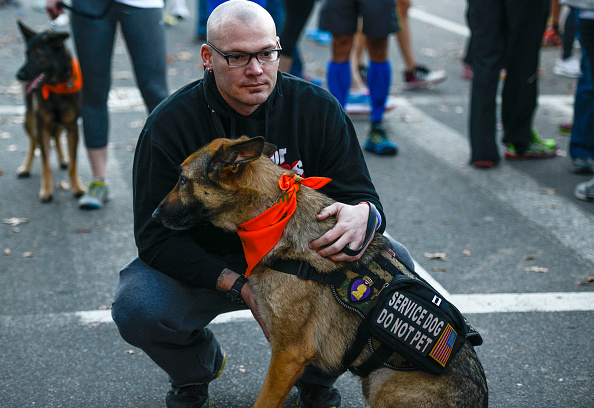
We found that, on average, service dogs respond to about 120 words, whereas family pets respond to nigh 80 words, ranging between 15 to 215 words across all dogs. We also plant that certain brood groups, such as herding dogs like border collies and toy dogs similar chihuahuas, reply to more words and phrases than other breed types like terriers, retrievers and mixed breeds.
What we don't yet know is whether dogs who respond to more words also accept better executive functions. We recently assessed 100 dogs on a behavioural measure of executive functions and had their owners identify words on our vocabulary checklist. We are now analysing the results.
I outset became interested in studying dogs to run across what they might tell us about kid evolution. That said, this research might as well provide important practical information nearly dogs. For example, it is very expensive to railroad train puppies for service work and many do not brand the final cutting. However, if early word-based responding abilities predict later behavioural and cognitive abilities, our measure could become an early and simple tool to assist predict which dogs are likely to go good service animals. 
Sophie Jacques, Associate Professor, Psychology and Neuroscience, Dalhousie Academy This article is republished from The Chat under a Creative Commons license. Read the original article.

Source: https://www.theepochtimes.com/yes-your-dog-can-understand-what-youre-saying-to-a-point_4229984.html
Posted by: boydreste1954.blogspot.com
0 Response to "Can You Have A Service Dog With Other Dogs"
Post a Comment